queering him, queering power
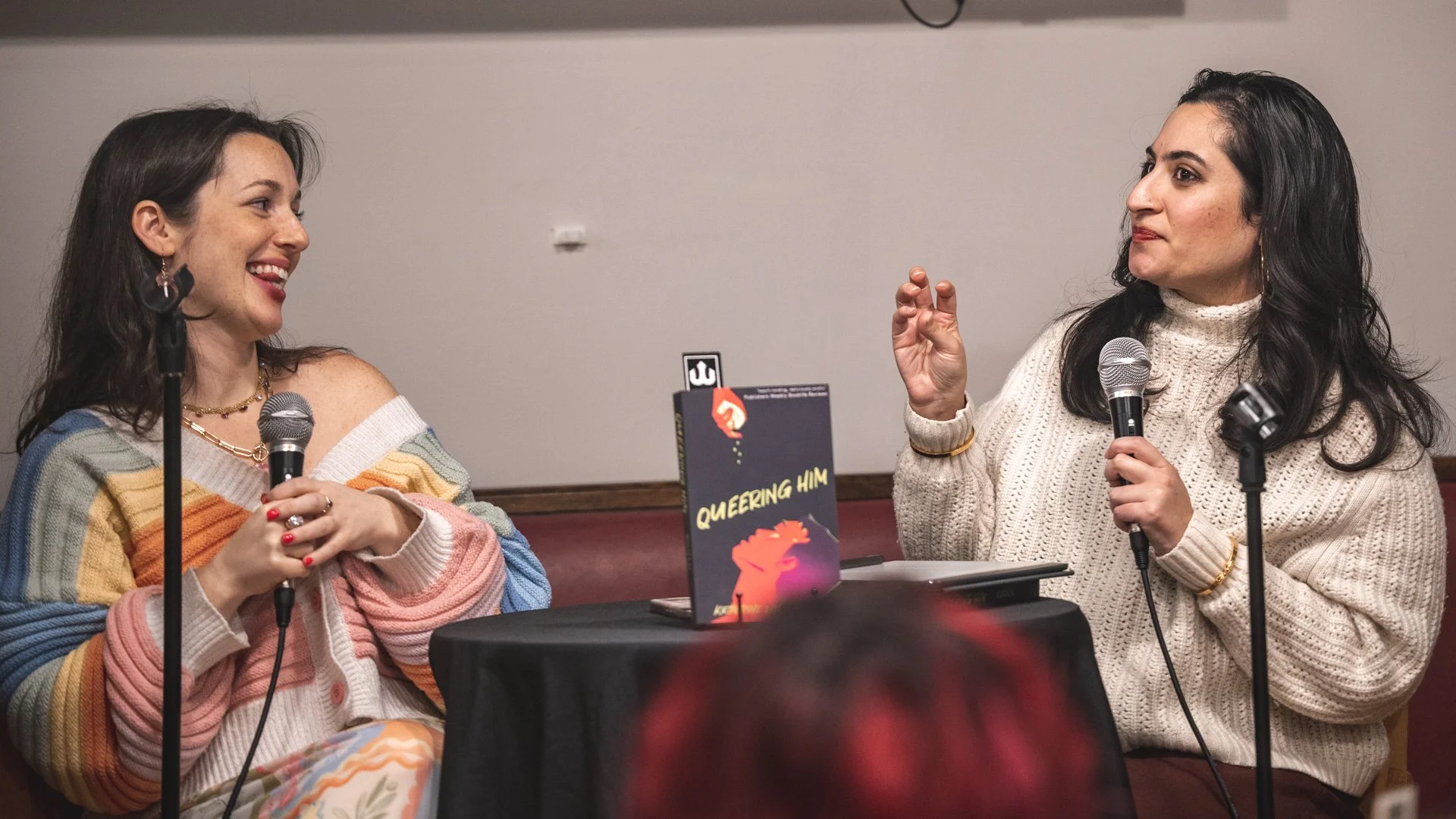
photo credit: Nate Lamkin
Last week, I had the honor and privilege of serving as a conversation partner for Katherine Wela Bogen’s book event — celebrating her debut novel Queering Him at Trident Bookstore in Boston.
I cold-pitched myself for this gig assuming it would be a no (chasing those 1000 rejections!). Instead, I got to spend an evening asking one of my newly favorite authors everything I wanted to know about her book — which just came out last week and is already one of my favorite books this year. (In what universe do we get chances like that?!)
Our discussion turned out to be one of the most thought-provoking conversations I've had in a long time about power, harm, and the binaries we accept without question.
Katie refuses to let her characters be simply powerful or powerless. Kieran and Avra exchange care and tenderness, but also violence — shared experiences and shared identities, but also deeply divergent nuances of those identities. Neither character “gets” to be merely villain or victim.
So often, we flatten power into binaries when the reality is far queerer than that.
Most people exist at intersections of privilege and oppression. We hold power in some dimensions and lack it in others. We’ve experienced the trauma of being harmed AND we’ve wielded power in ways that caused harm. We’ve internalized shame about how we don’t conform, and then we’ve weaponized it — against ourselves or others.
But I get curious about how conflict emerges precisely because power is much more complex than the binaries we try to smash them into.
What if our inability to hold multiple truths at once — that we can both be harmed and also cause harm — is part of what makes conflict feel so intractable, so jagged, so hard to recover from?
I’ve been a reader and a writer my entire life, but lately I’ve been delighting in the ways that fiction gives me permission to explore these contradictions in ways that organizational theory and behavioral psychology and systems change sometimes can’t.
Stories let us play with the mess. They offer us characters who are neither villains nor victims, but fully human — mirrors to our own complex interiors.
A week later, I’m still thinking about how much we lose when we insist on flattening people into singular narratives about power — and how much relational capacity we could build if we got more comfortable with the queer, multi-dimensional truth of how power actually operates.